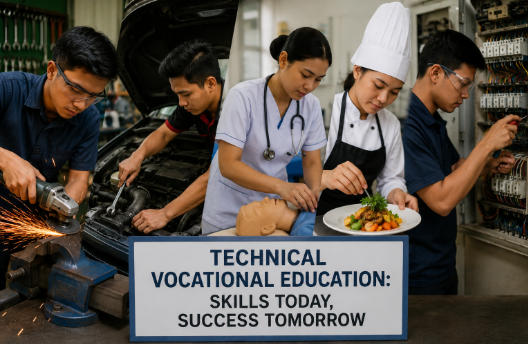
For many years, society has often viewed a college degree as the primary route to a successful career. Parents encourage their children to attend university, believing that a bachelor’s degree offers the best chance for stable employment and financial security. While higher education remains valuable and necessary for many professions, technical-vocational education offers an alternative path that deserves equal recognition and respect.
Technical-vocational courses focus on practical skills and hands-on training that prepare students for specific occupations. These programs include fields such as welding, automotive repair, electrical installation, plumbing, caregiving, culinary arts, information technology support, and many others. In the Philippines, organizations such as Technical Education and Skills Development Authority have played an important role in promoting technical-vocational education and skills development.
One of the greatest advantages of a technical-vocational course is the shorter training period. While a college degree typically requires four or more years of study, many vocational programs can be completed within a few months to two years. This allows graduates to enter the workforce sooner and begin earning an income earlier than many college students.
Another major advantage is lower educational cost. College tuition, books, transportation, and other expenses can place a significant financial burden on families. Technical-vocational courses are often more affordable, making them accessible to a broader range of students. For many families, this can mean less debt and a quicker return on educational investment.
Technical-vocational education also emphasizes practical, job-ready skills. Students spend much of their training learning by doing rather than simply studying theory. As a result, graduates often possess skills that employers need immediately. An electrical technician, automotive mechanic, or welder can frequently begin productive work on the first day of employment because of the hands-on nature of their training.
Demand for skilled workers remains strong in many industries. Construction, manufacturing, transportation, healthcare support, hospitality, and technology services continually require qualified technicians and skilled tradespeople. In some cases, employers report shortages of skilled workers even while college graduates struggle to find jobs related to their degrees. This means vocational graduates may enjoy better employment opportunities in certain sectors.
Another advantage is flexibility. Many vocational skills can lead to self-employment and entrepreneurship. A trained electrician, plumber, beautician, or computer technician can establish a small business and gradually expand it. Rather than relying solely on employers, skilled workers often have the opportunity to create their own source of income.
Technical-vocational education can also provide opportunities for overseas employment. Countries around the world seek skilled workers in healthcare support, construction, engineering support services, hospitality, and other technical fields. Proper certification and experience can open doors to higher-paying opportunities abroad.
It is important, however, not to view technical-vocational education and college education as competitors. They serve different purposes and meet different needs. Certain professions—such as medicine, law, engineering, teaching, and accounting—require formal university degrees and extensive academic preparation. At the same time, society cannot function without skilled technicians, craftsmen, and tradespeople.
The best educational path depends on an individual’s talents, interests, financial circumstances, and career goals. Some people thrive in academic environments and pursue university degrees. Others excel through practical training and hands-on work. Neither path is inherently superior; both contribute to economic growth and community development.
In the modern economy, success depends less on the title of one’s diploma and more on the ability to provide value through knowledge, skills, reliability, and continuous learning. Technical-vocational education offers a practical, affordable, and often highly rewarding route to a meaningful career. For many individuals, it is not a second choice—it is the right choice.
Ultimately, society benefits when all forms of education are respected. Whether one becomes an engineer, a nurse, a welder, a chef, or an automotive technician, every skilled worker plays a vital role in building a stronger and more prosperous nation.